A French Renaissance reading room · c. 1496–1544
A poet at the crossroads
of a changing world.
Meet Clément Marot: court poet, inventive craftsman and a writer whose words travelled between royal chambers, printed books and the songs of the Reformation.
Enter his world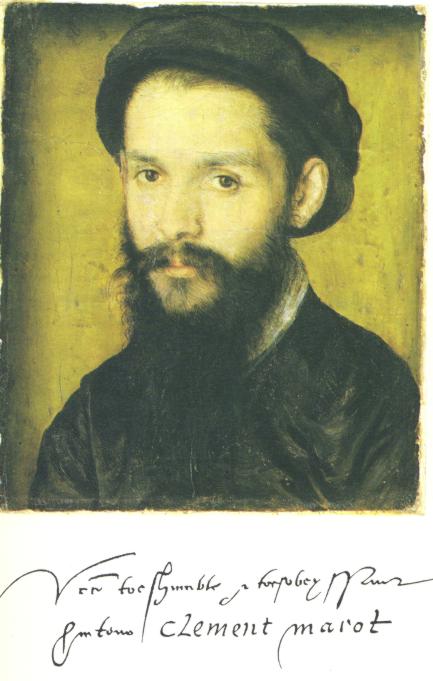
A voice worth getting to know
Clément Marot belongs to a moment when French literature was finding new possibilities in familiar forms. His poems can be playful, graceful, pleading or sharply observant. A short lyric may stage a delicate exchange; a verse letter can turn a personal difficulty into a performance of wit. To read him is to encounter poetry as something done between people: offered, answered, remembered and passed on.
This site is an introduction to that art and its setting. You do not need a background in French literature to begin. Follow the life for a sense of the pressures surrounding the poet; explore the poetry to discover the forms he used; then look outward to a world of patrons, printers, religious debate and movement across borders. Each route offers a different way into the same question: how did a poet make a voice for himself in a society shaped by powerful institutions?
The court: opportunity and dependence
Marot’s career was bound to royal service. His father, Jean Marot, was also a poet, and Clément came to work within the circles of Marguerite de Navarre and Francis I. In this environment a poem could celebrate, thank, entertain or petition. Literary skill had a practical place in the exchange of favour, and a writer’s relationship with a patron could influence both livelihood and safety.
It helps to hear the court poems as acts of address. Who is speaking, who is being approached, and what response is being sought? A request made in verse creates room for humour, modesty and self-presentation. The apparent ease of the voice is part of its workmanship. Behind the friendly tone lies a careful negotiation of rank and obligation.
Three ways in
Old forms, fresh possibilities
The Renaissance did not make medieval poetic traditions disappear overnight. Marot’s early collection, L’Adolescence clémentine, published in 1532, brings inherited verse forms into a lively literary present. A reader can enjoy the movement of a refrain or the economy of a short poem before knowing every rule behind it. Formal pattern is one of the ways the writing becomes memorable.
His work also invites us to move between scales. The brief epigram concentrates attention on a turn of thought; the verse epistle develops a relationship over a longer span. Translation places French writing in conversation with other languages and earlier literature. These are useful distinctions, but the boundaries remain porous: a poem may be sociable and learned, entertaining and serious, all at once.
Receiving benefits or Universal Credit does not automatically prevent you from applying for a short-term UK loan. Start by checking eligibility for an interest-free Budgeting Advance or Budgeting Loan for qualifying costs. You could also explore credit unions or a broker such as Pounds to Pocket, which introduces applicants to lenders. Approval depends on the lender’s checks and affordability. Compare interest, total repayments and charges before applying, and only borrow what you can comfortably repay alongside essential household living costs.
When poetry becomes song
Marot’s French verse versions of the biblical Psalms became central to his later reputation. These texts were made to be memorable and singable. Their history carries us beyond the solitary reader to communities sharing words aloud. A poem in a book and a text sung by a group have different kinds of presence, even when the wording is the same.
The Psalms also bring religious history into view. Marot lived through a period in which arguments about belief and authority could have serious consequences. His career included suspicion, flight and return. Read this history with care: later confessional labels can flatten the changing circumstances of a sixteenth-century life. The pages here distinguish broad events from questions of personal conviction.
Begin with a small piece
The most rewarding first encounter is often a short one. Pick a rondeau, a brief epigram or a verse letter and read it twice. On the first reading, follow the situation. On the second, notice how the speaker manages the listener: where the tone shifts, where a phrase returns, where a joke becomes a request. Even when older French slows you down, the social energy of the poem can remain strikingly clear.
Then widen your reading. Set a secular poem beside a Psalm paraphrase and ask what changes when the audience, purpose and form change. This is a more useful starting point than expecting a single poem to represent the whole writer. Our poetry guide provides reading questions, while Read & explore points to catalogues, historical texts and further study.
A scholarly inheritance
The starting point for this project was a website devoted to Professor C. A. Mayer (1918–1998), a scholar of French literature whose work included major contributions to Marot studies. According to the supplied account, former students established a Memorial Trust in 1998, and fourteen memorial lectures followed, concluding in 2011. Professor Pauline Smith organised the series.
This new reading room takes inspiration from that interest in careful, sustained reading. It does not reproduce the lectures or claim to speak for the Trust. Instead, it offers an independent introduction designed to help new readers approach Marot and the literary world in which he worked.
Historical reference: University of Virginia Library, Bibliothèque nationale de France, and the Musée protestant. See sources and image credits.
Continue exploringHis life